
Agribusiness Study Program, Batang Campus, Faculty of Animal and Agricultural Sciences, Universitas Diponegoro (UNDIP), successfully held an international academic event titled UNDIP Global Classroom with the theme “Contemporary Strategies and Challenges in Agribusiness Marketing in the Global Market.”
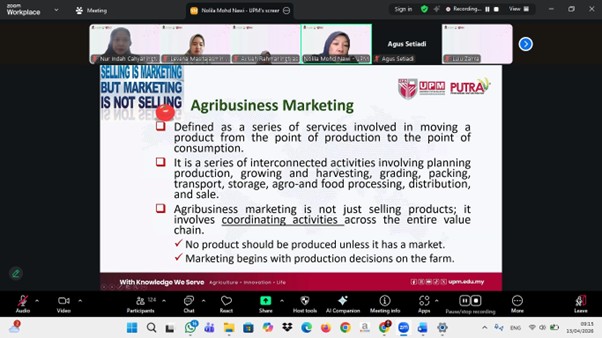
The event featured Assoc. Prof. Dr. Nolila Mohd Nawi (Universiti Putra Malaysia) as the speaker, who shared her expertise and insights on current trends and challenges in global agribusiness marketing, and was moderated by Levana Masitajasmin Putri, S.E., M.Si, a lecturer of the Agribusiness Study Program, Batang Campus, UNDIP. The session was attended by academic staff and students from various backgrounds, reflecting strong enthusiasm for global knowledge exchange.
The event was officially opened by the Vice Dean II of the Faculty of Animal and Agricultural Sciences, Prof. Agus Setiadi and concluded with an interactive discussion and virtual group photo session involving all participants.
In her presentation, Assoc. Prof. Dr. Nolila highlighted that agribusiness marketing today is becoming increasingly dynamic, driven by several key trends, among them changing consumer preferences. Consumers are now more selective, with growing interest in health, sustainability, product transparency, and value-added products. This shift requires agribusiness actors to continuously adapt their marketing strategies.
However, she also emphasized that following these trends is not without challenges. Agribusinesses often face issues such as rising marketing costs, strong global competition, and the need to balance meeting consumer demands with maintaining efficiency. In addition, short-term market trends such as viral products driven by social media can create sudden demand but also pose risks, such as oversupply and price instability.
The discussion session provided valuable insights on how agribusiness actors can respond to these challenges by developing adaptive, innovative, and sustainable marketing strategies. Participants actively engaged in the session, raising relevant questions related to real-world conditions faced by farmers and agribusiness practitioners.
Through this activity, participants are expected to gain a deeper understanding of how agribusiness marketing continues to evolve and how they can contribute to developing more resilient and competitive agricultural sectors in the future.